I did not go to Japan to find myself. I went because I had wanted to go for back twenty years, and one morning in January I stopped wanting and started booking.
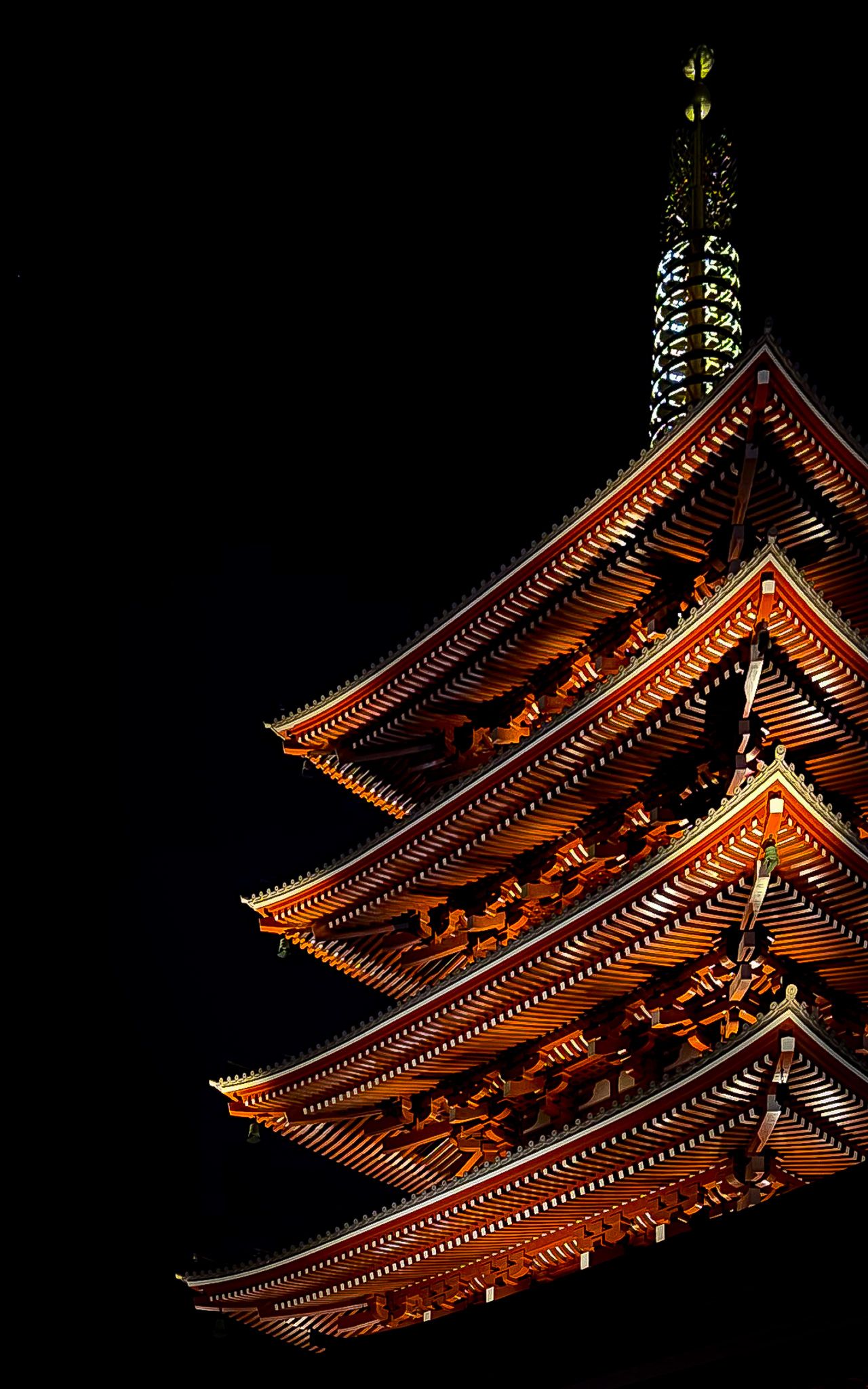
Eight days. Tokyo for six, a quick overnight to Kyoto, then back for a final morning before the flight home from Narita. No tour group, no JR pass, no itinerary printed and laminated. Just a master plan I had written myself, a Suica card, and a pair of boots that had already done their miles.
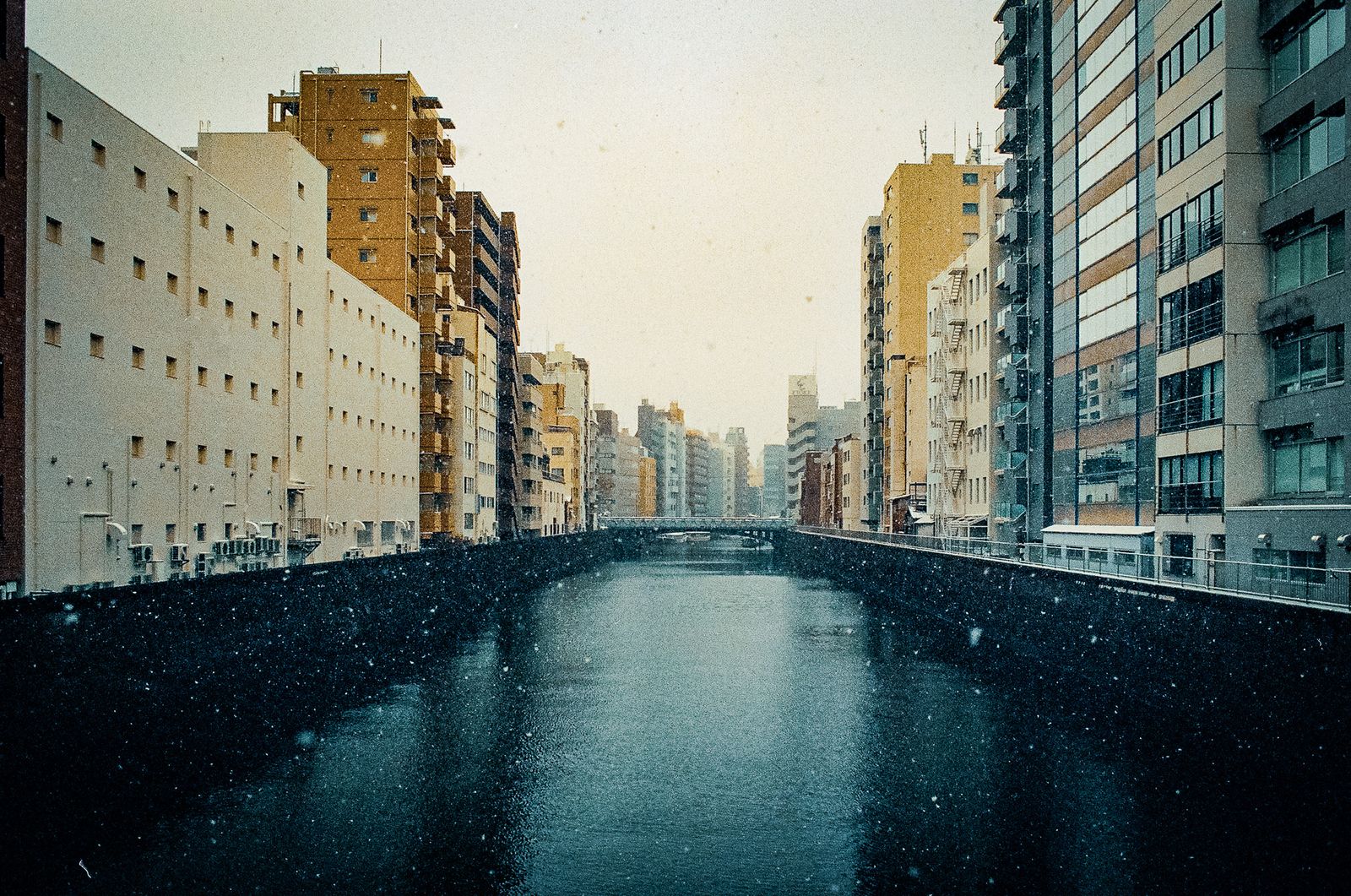 Canal in the snow — Tokyo, Japan
I landed at Narita on a Friday afternoon in February. Sixteen hours in the air from the Pacific Northwest, a connection through Seattle, and by the time I cleared immigration I was running on something between adrenaline and stubbornness. The Keisei Access Express took me straight to Asakusa without a single transfer. I tapped my Suica card at the gate, walked twelve minutes through cold, quiet streets to the hostel, and that was it. I was in Tokyo. I bought a hot can of coffee from a vending machine on the corner because it was February and I was awake and it was there, glowing orange in the dark.
The Suica card deserves its own paragraph because it changed the way I moved through the country. You buy one at any station, load it with yen, and from that moment you stop thinking about tickets. Tap on at the gate, tap off when you arrive, and the system calculates the fare. It works on JR trains, Tokyo Metro, private railways, buses. It works at convenience stores and vending machines. I put mine in Apple Wallet on day one and never touched cash for transport again. The friction between wanting to go somewhere and actually going there just disappeared. In a city this size, that matters more than you think. (used with a global money account, like HSBC's, or the Wise versions, even easier!)
And then there is the Shinkansen. I took one to Kyoto and back, and it remains the single best piece of public transport I have ever used. You walk into Tokyo Station, buy a ticket at the machine, find your platform, and board a train that does 300 kilometres an hour so smoothly you could balance a glass of beer on the armrest without spilling a drop. The seats are wider than business class on most airlines. The legroom is absurd. It arrives on time to the second. Fourteen minutes late in Japan is a national news story. Two hours and fifteen minutes later I was in Kyoto, stepping onto a platform that was clean enough to eat off. The return was the same. No delays, no crowds fighting for seats, no confusion. If you are treating yourself, the Green Car is worth the upgrade. Wider seats, more space, quieter carriages, and a sense that you are travelling the way the country intended trains to work.
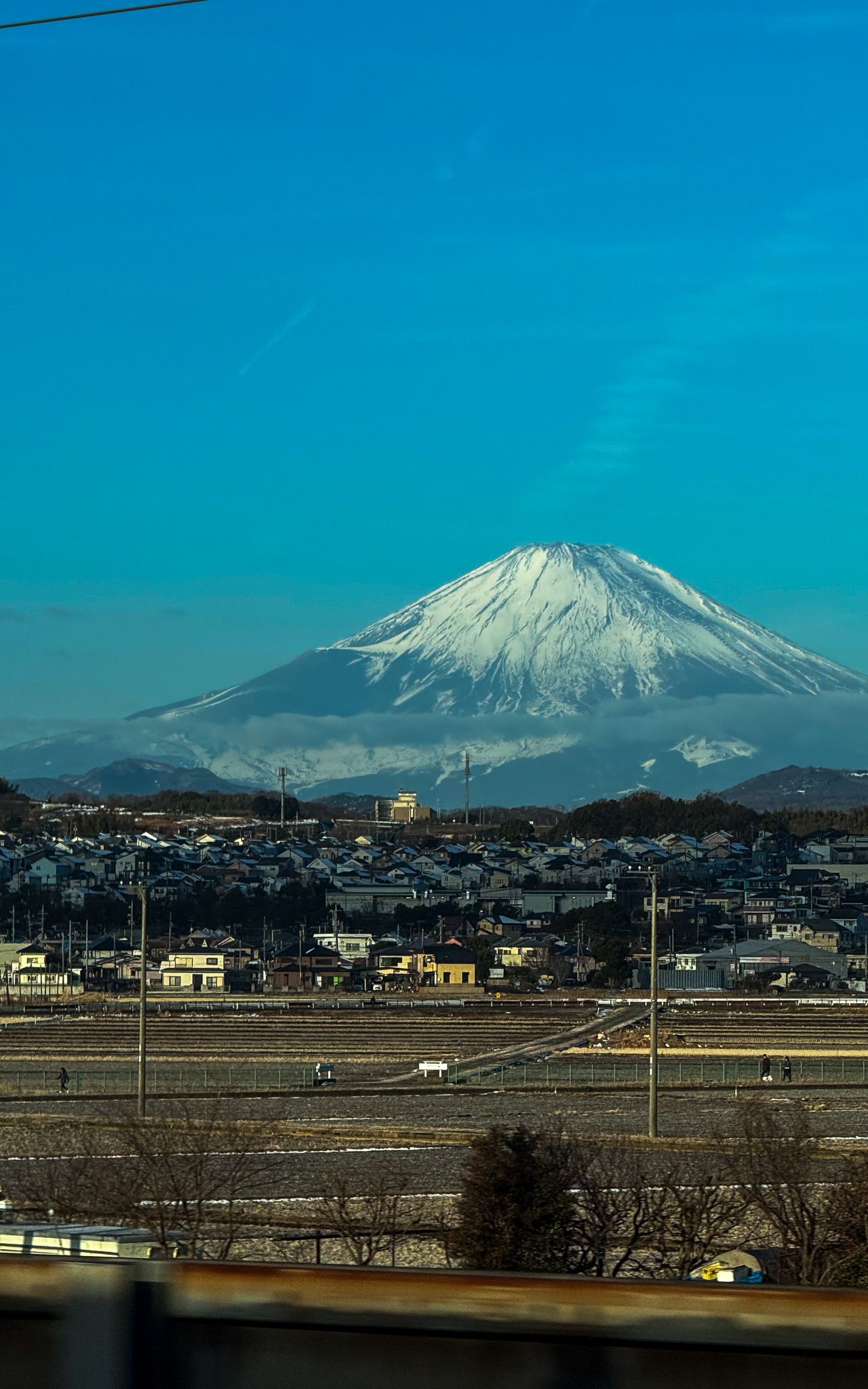
Not all the trains were that fast, and some of the best ones were the opposite. One morning I took the train south to Enoshima, changing at Fujisawa onto the Enoden, a single-track electric railway that has been running since 1902 and feels like it. The carriages are narrow, the seats worn smooth, and the line threads through residential streets so close to the houses you could reach out and touch someone's laundry. It rattles along the coast past Kamakura and then out onto the causeway to the island itself. Enoshima was quiet in February. Cold wind off Sagami Bay, a shrine up the hill, cats everywhere, and a view of Fuji on a clear day that I did not get because the clouds had other plans. But the train was the point. There is something about riding a piece of infrastructure that old, still working, still full of commuters and schoolchildren treating it like any other Tuesday, that makes you recalibrate what you think of as modern. The Shinkansen is the future. The Enoden is the proof that the past still runs on time.
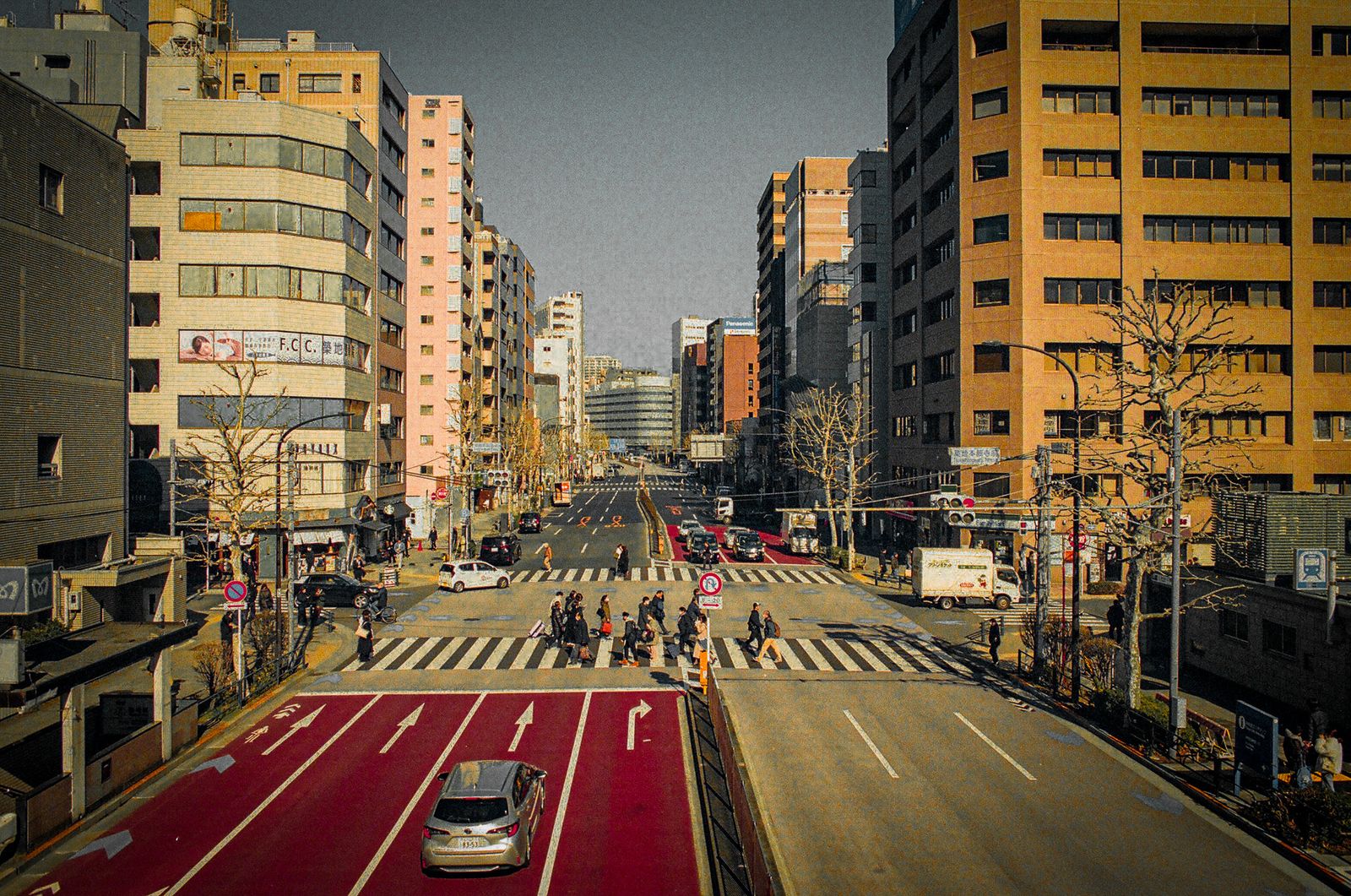 Avenue from the footbridge — Shinjuku, Tokyo
Tokyo itself is not one city. It is dozens of villages pressed together, each with its own rhythm. Asakusa, where I was based for the first six nights, felt like old Tokyo. Quiet mornings, the smell of incense from Senso-ji drifting through cold air, shop owners sweeping their frontages before seven. I walked to Yanaka one morning through backstreets that felt more like a country town than the capital of the world's third-largest economy. An old woman at a corner shop sold me hot canned coffee from a machine and bowed so deeply I felt like I should bow back twice.
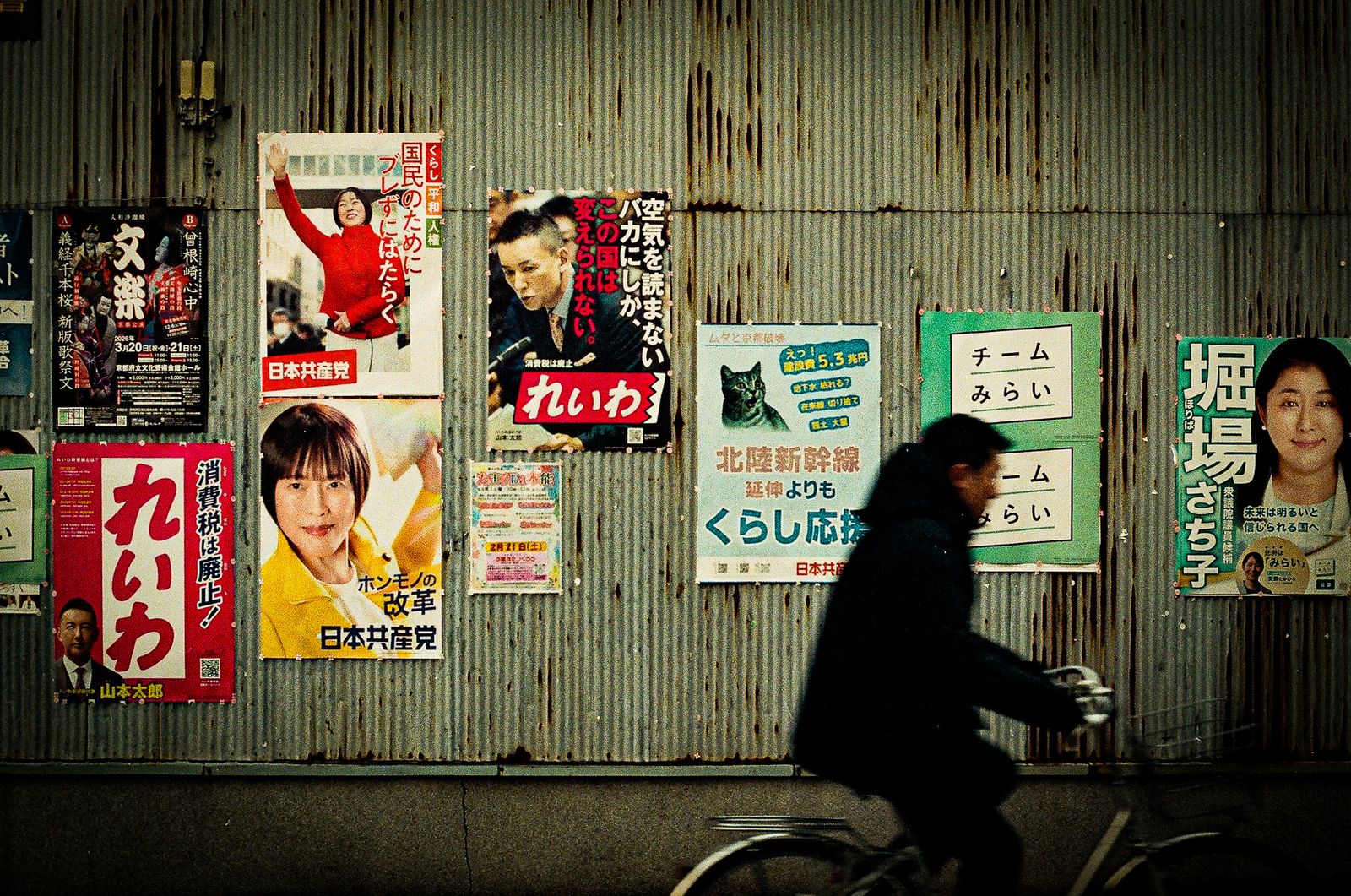 Cyclist and election posters — Tokyo, Japan
Not every day worked. Day three, the jet lag came for me properly. I had been running on early mornings and adrenaline and at about two in the afternoon my body decided it was midnight and I was done. I sat down in a Doutor coffee shop near Ueno, ordered a coffee I did not finish, and stared at a wall for forty minutes before admitting defeat and going back to the hostel. I slept until six, woke up disoriented and furious with myself, and then went out and had one of the best evenings of the trip at a standing bar under the Ameyoko tracks. The city does not care about your schedule. It is still there when you come back.
The food was relentless in the best possible way. I had planned targets before I left, places and dishes I specifically wanted to eat, but the best meals were the ones I did not plan at all. A bowl of ramen in Shinjuku at a counter with eight stools where the cook did not speak a word of English but understood "kore onegaishimasu" and a pointed finger perfectly. Yakitori at Omoide Yokocho, standing at a grill the width of a dining table while smoke and conversation filled the narrow alley. Takoyaki from a Gindaco stand, eaten on a park bench in the cold because they were too hot to wait for. Egg sandwiches from 7-Eleven at six in the morning because I was jet-lagged and awake before dawn and they were right there, soft white bread and creamy egg, better than most cafe versions back home for a dollar fifty.
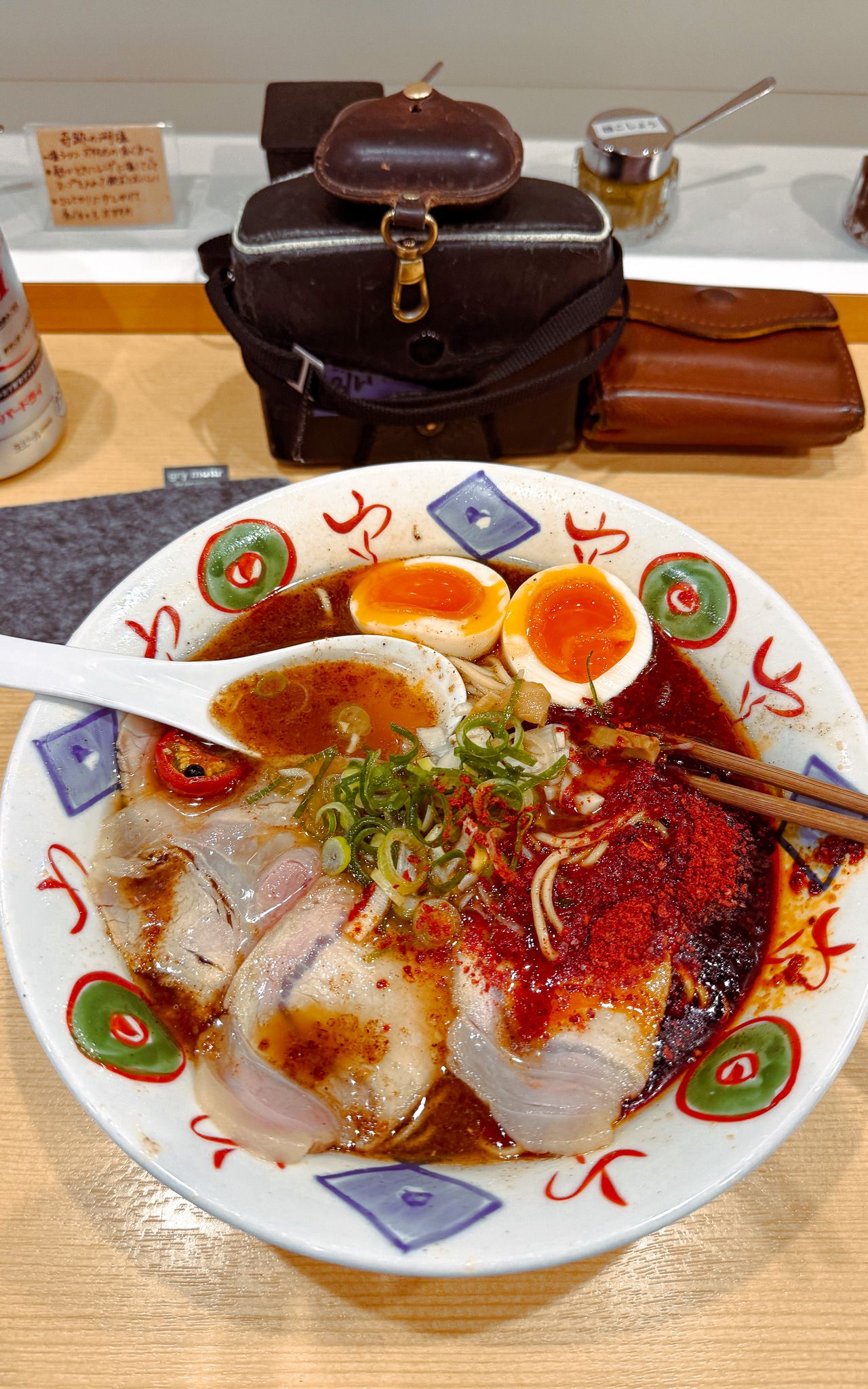
The ramen ordering system deserves a word because it is one of those small design details that tells you everything about how Japan thinks. You do not walk in and wait for a menu. You stand outside, study a vending machine bolted to the wall, feed it cash, and press the button for what you want. A ticket drops out. You hand it to the cook when you sit down. No conversation required, no fumbling with a card reader, no tipping calculation. Just choose, pay, sit, eat. The machines themselves are a kind of menu board, photographs of every dish backlit behind plastic buttons, usually with prices that would embarrass most American fast casual chains. The whole process takes about thirty seconds and removes every point of friction between you and a bowl of noodles. The only moment of mild comedy, repeated at almost every machine I used, was the little American flag button for English. It works, the translations are passable, and you will press it without shame because the alternative is guessing which kanji means extra chashu. But seeing that flag on a machine in a back alley in Shinjuku, wedged between a laundromat and a pachinko parlour, does make you wonder how often the locals notice it at all.
I went to Tsukiji because you have to, even though the inner market moved to Toyosu in 2018 and what remains is the outer market, which is now more tourist corridor than working fish trade. The tuna auctions are gone. The forklifts are gone. What is left is a grid of stalls selling tamagoyaki, fresh uni, grilled scallops on sticks, and matcha soft serve to a crowd that is ninety percent holding phones above their heads. But I went early, before nine, and at that hour you can still find the stalls that are there for the chefs rather than the visitors. I had a plate of sashimi at a counter where the man behind it selected each piece like he was performing surgery, and it was the best fish I ate in Japan, which is saying something when you are in a country where the baseline for fish is already unreasonable. Tsukiji is touristy now, no question, but a place does not survive that long on reputation alone. The bones of it are still there if you show up early enough and walk past the queues.
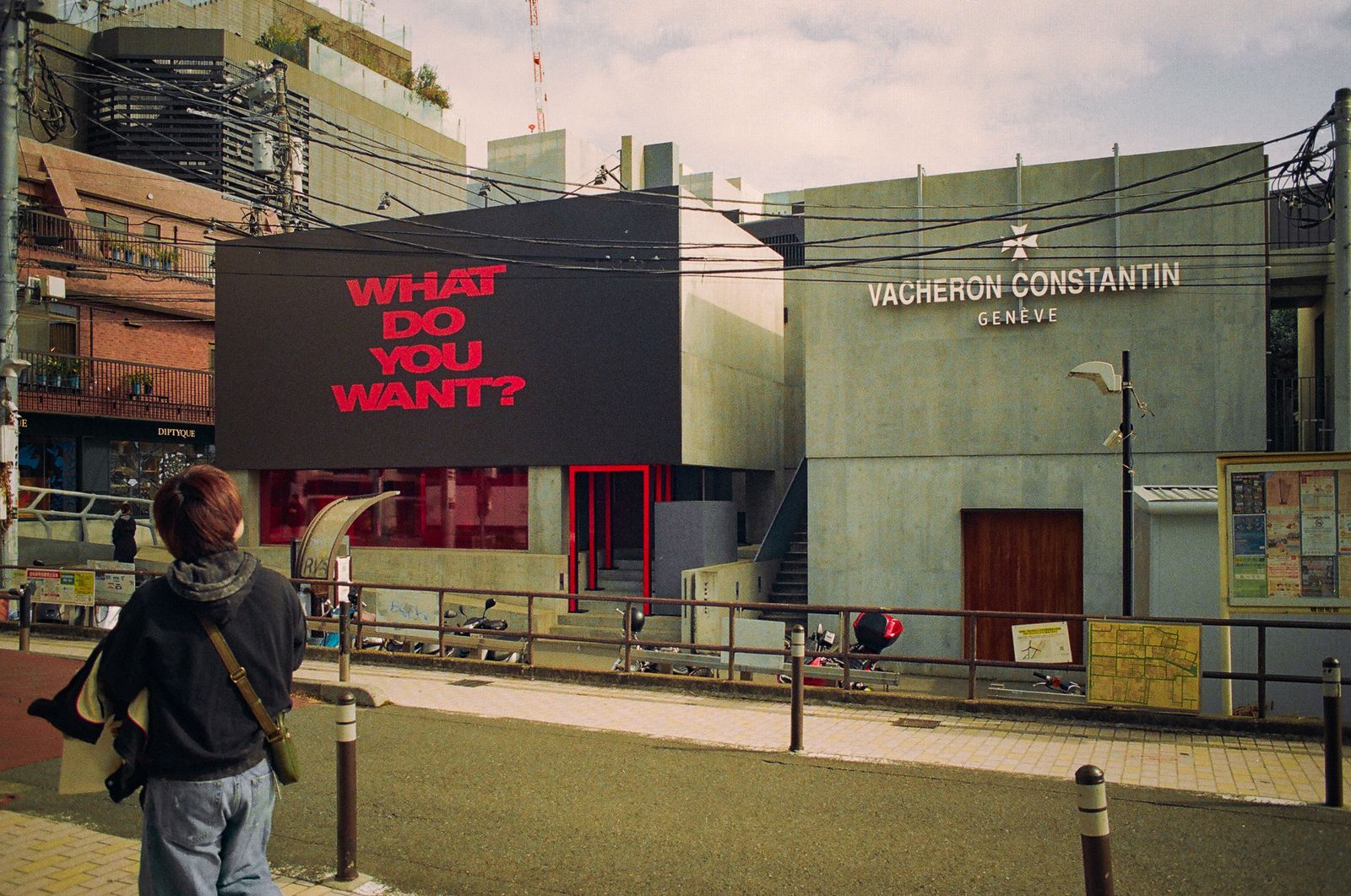 What do you want? — Ginza, Tokyo
The breweries were a revelation. I work in hops and beer, I have spent the better part of my career selling them, thinking about them... So walking into a Japanese craft brewery is not tourism for me, but I still love it. It is fieldwork.
Hitachino Brewing Lab at Manseibashi was worth the visit for the building alone, a converted railway station arch with exposed brick and trains rumbling overhead. The Nest beers are solid, the white ale in particular, and they have dialled in the kind of consistency that most craft breweries take a decade to achieve.
But the real discoveries were the smaller places. Japandemic in Nakameguro, a tiny bar with a serious tap list and a lean toward natural-process Japanese craft that felt like the future. Perfect Beer Kitchen on the Ebisu edge, where the draft condition was immaculate, every pint poured exactly right. Ushitora in Shimokitazawa, hiding in the back streets of a neighbourhood that still feels like old Brooklyn before anyone noticed. And then there was Popeye Beer Club in Ryogoku, which has seventy taps and manages to keep every single one of them in good condition, which is a logistical achievement that anyone in this industry would respect.
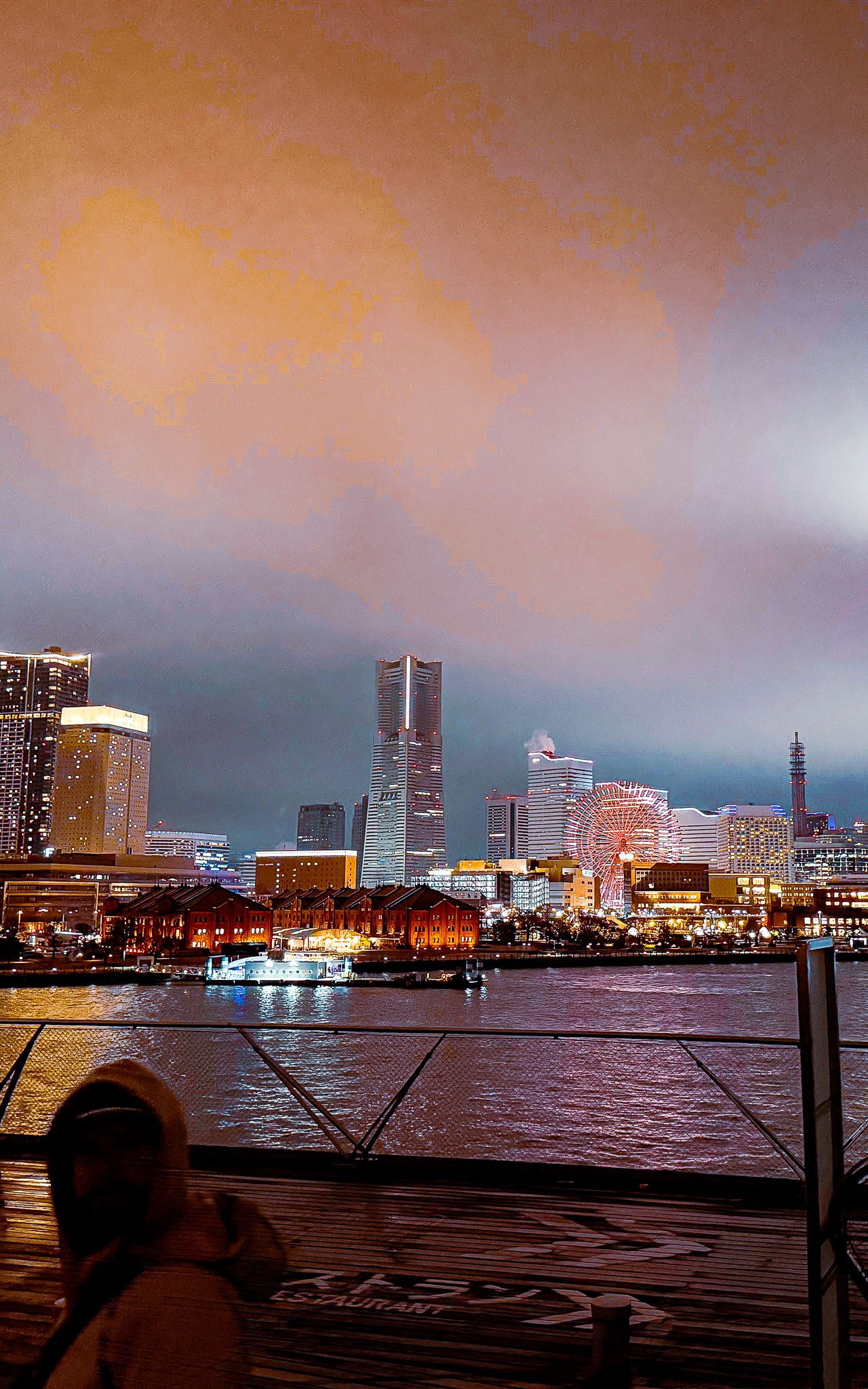
I also lucked into the Japan Brewers Cup at Yokohama Osanbashi Hall, about thirty-five minutes from Shibuya on the Minatomirai Line. A proper competition and festival, not a marketing exercise. Breweries from across Japan pouring their best work, judges taking it seriously, and a crowd that was there because they cared about beer rather than because it was a thing to do on a Saturday. For someone who spends his working life thinking about what brewers want and how they source it, watching the Japanese craft scene compete at that level was genuinely instructive. The technical standard was high. The variety ambition was higher. I left with a notebook full of names I had not heard before and a strong sense that the Japanese craft market is further along than most people in the American or European industry give it credit for.
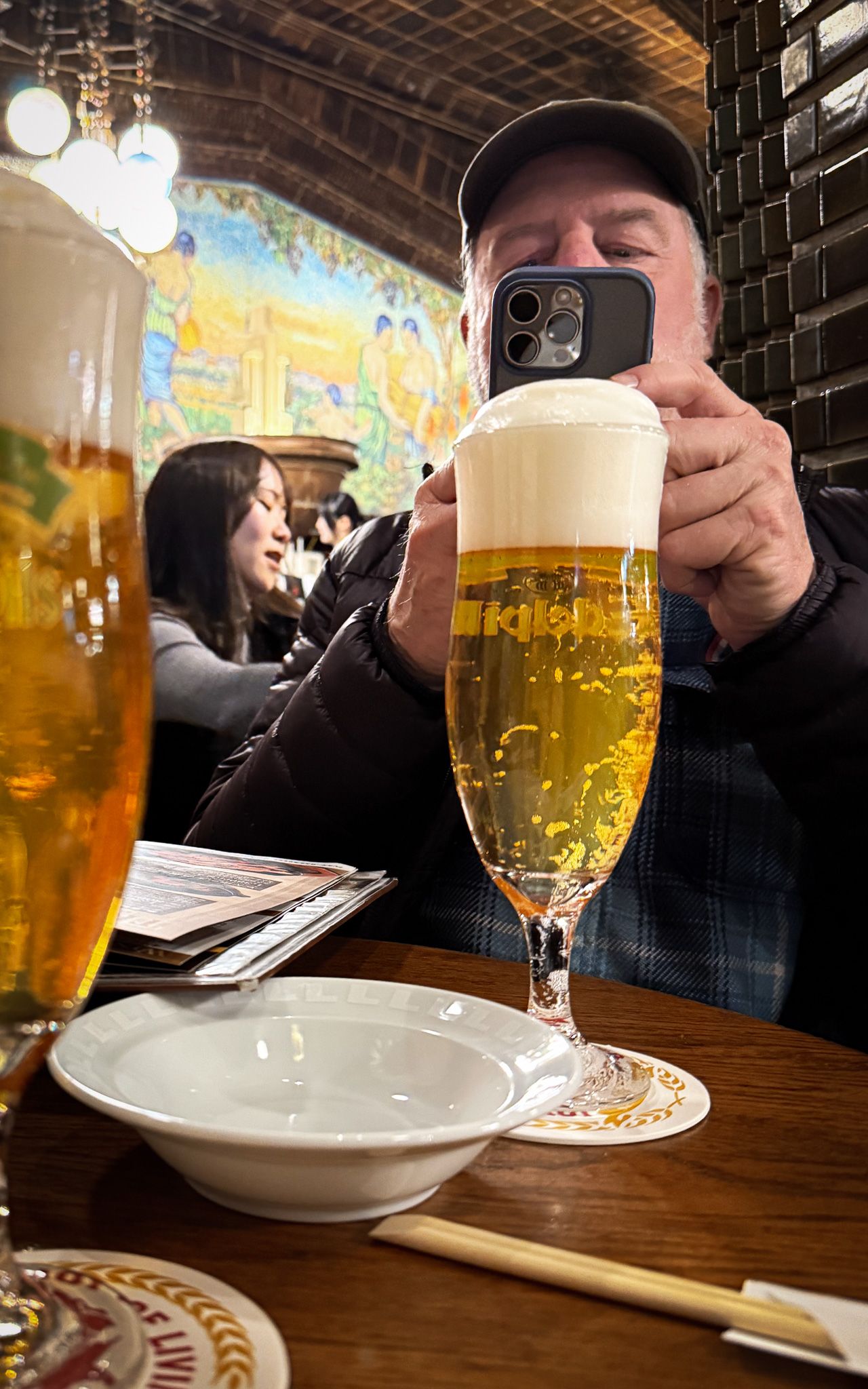
And then there was the Ginza Lion. Not craft, not new, not trying to be anything other than what it has been since 1934. The Beer Hall on Chuo-dori is the oldest continuously operating beer hall in Japan, a Sapporo institution with Art Deco mosaic tiles on the walls, stained glass panels filtering the light, and a ceiling that makes you look up before you sit down. The pour is ritual. The staff tilt the glass at exactly the right angle, build the head in stages, and present you with a beer that looks like it belongs in a textbook. It is Sapporo draft, nothing exotic, but served with a precision that turns a standard lager into something worth paying attention to. I sat at the long counter on a Tuesday afternoon surrounded by salarymen loosening their ties, retirees reading newspapers, and a couple of tourists who had clearly stumbled in and could not believe the room they were standing in. The Ginza Lion is not a place you discover. It is a place that has been waiting for you to arrive for ninety years, and it does not care whether you know anything about beer. It only asks that you sit down, drink slowly, and respect the room.
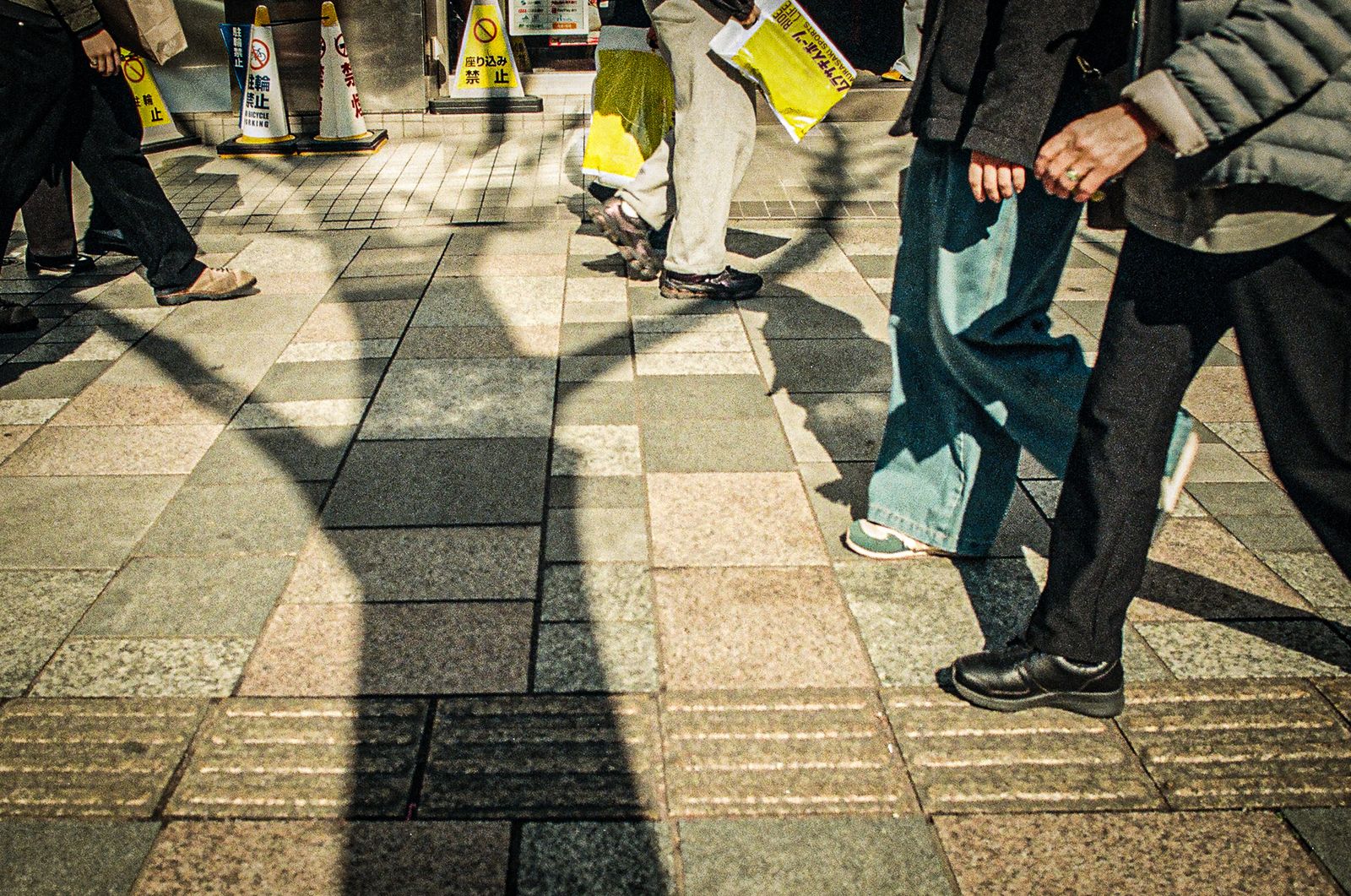 Shadows and shopping bags — Ginza, Tokyo
Ueno's Ameyoko market at early evening is its own category. Standing beer stalls under the railway tracks, older locals on plastic crates drinking cans of Asahi, smoke from grilled squid mixing with the cold air. Nobody was trying to impress anybody. Nobody was curating an experience. It was just people drinking beer outside because that is what they do after work, and they made room for me without hesitation.
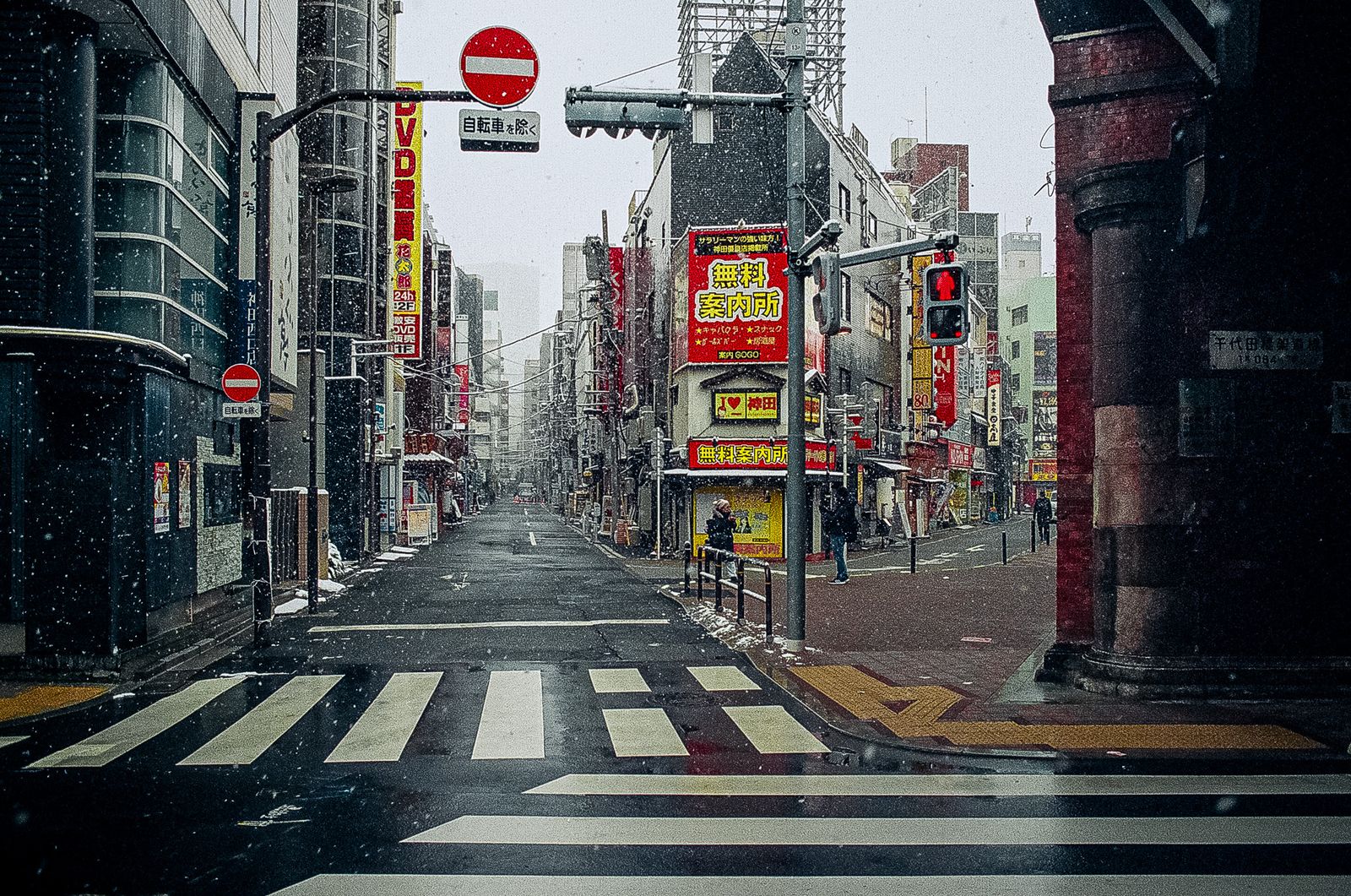 Snowy side street — Shinjuku, Tokyo
A woman at Asakusa station noticed me looking at the subway map and walked me to the correct platform. Not pointed. Walked. She was going the other direction. A barman at a tiny counter in some backstreet, a place that held six people and where my Japanese extended to "beer please" and "thank you", spent twenty minutes teaching me the correct way to say "oishii desu" and then poured me a second drink and refused to let me pay for it. And definitely no tips! The staff at my hostel drew me a hand-drawn map of their favourite breakfast spots on the back of a receipt, circling the ones that opened early enough for my jetlag schedule.
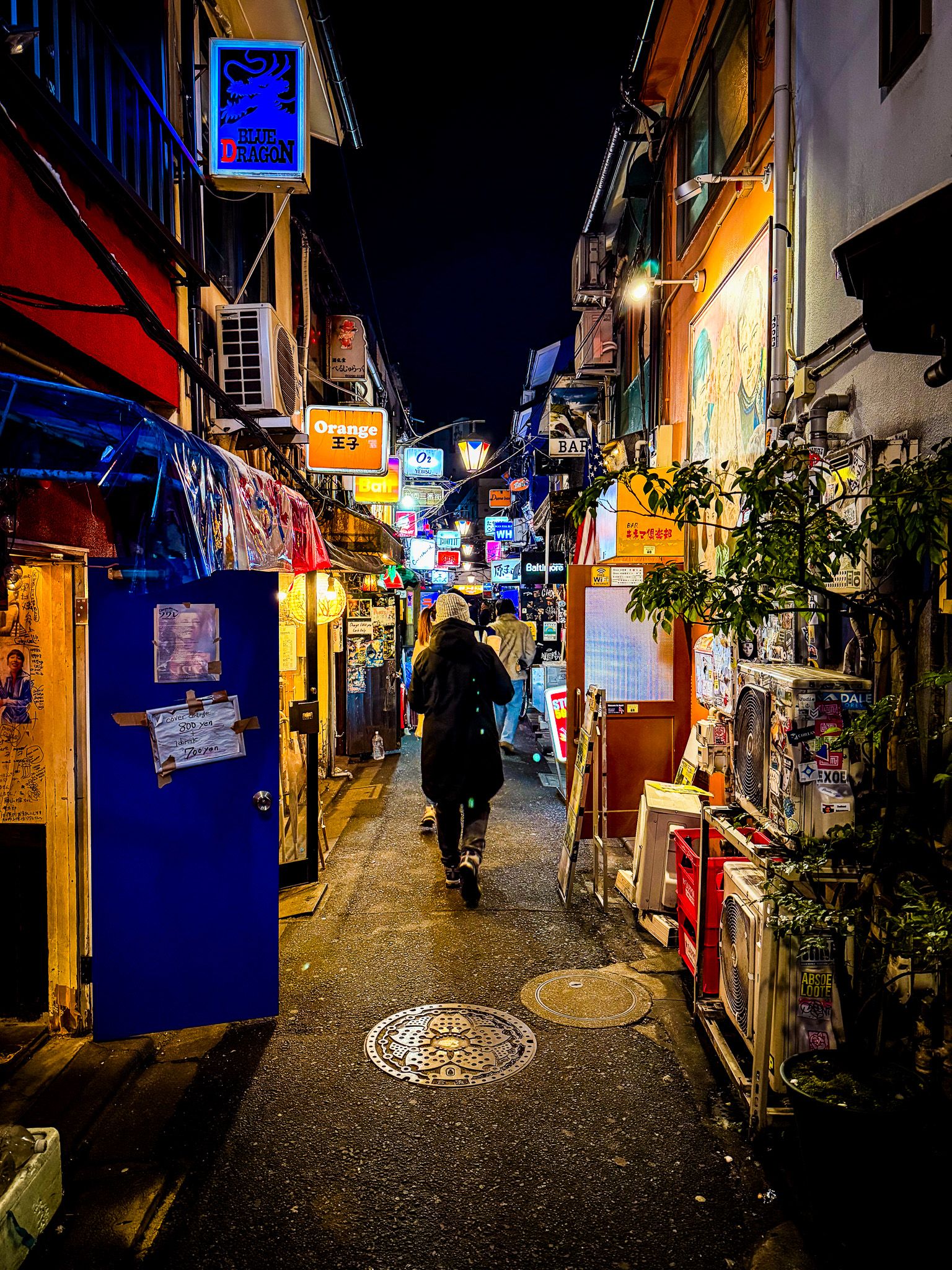
Golden Gai itself deserves a mention, not because any one bar was extraordinary but because the whole district operates on a principle that I find deeply appealing. Hundreds of bars, most the size of a single bed, many holding five to eight people at most. Some have "no foreigners" signs, which are language-based rather than personal. Cover charges can be steep for a space where you are essentially sitting in someone's living room. The trick is to go without a plan. Step into the first place with a free stool and a face behind the bar that looks interesting. One drink, then move. If the person next to you recommends somewhere, go. That is the system working. Golden Gai rewards surrender, not optimisation. I could write a paper on what it teaches about choice architecture and decision fatigue, but this is a blog post, so I will just say it was worth the curiosity and silliness, once.
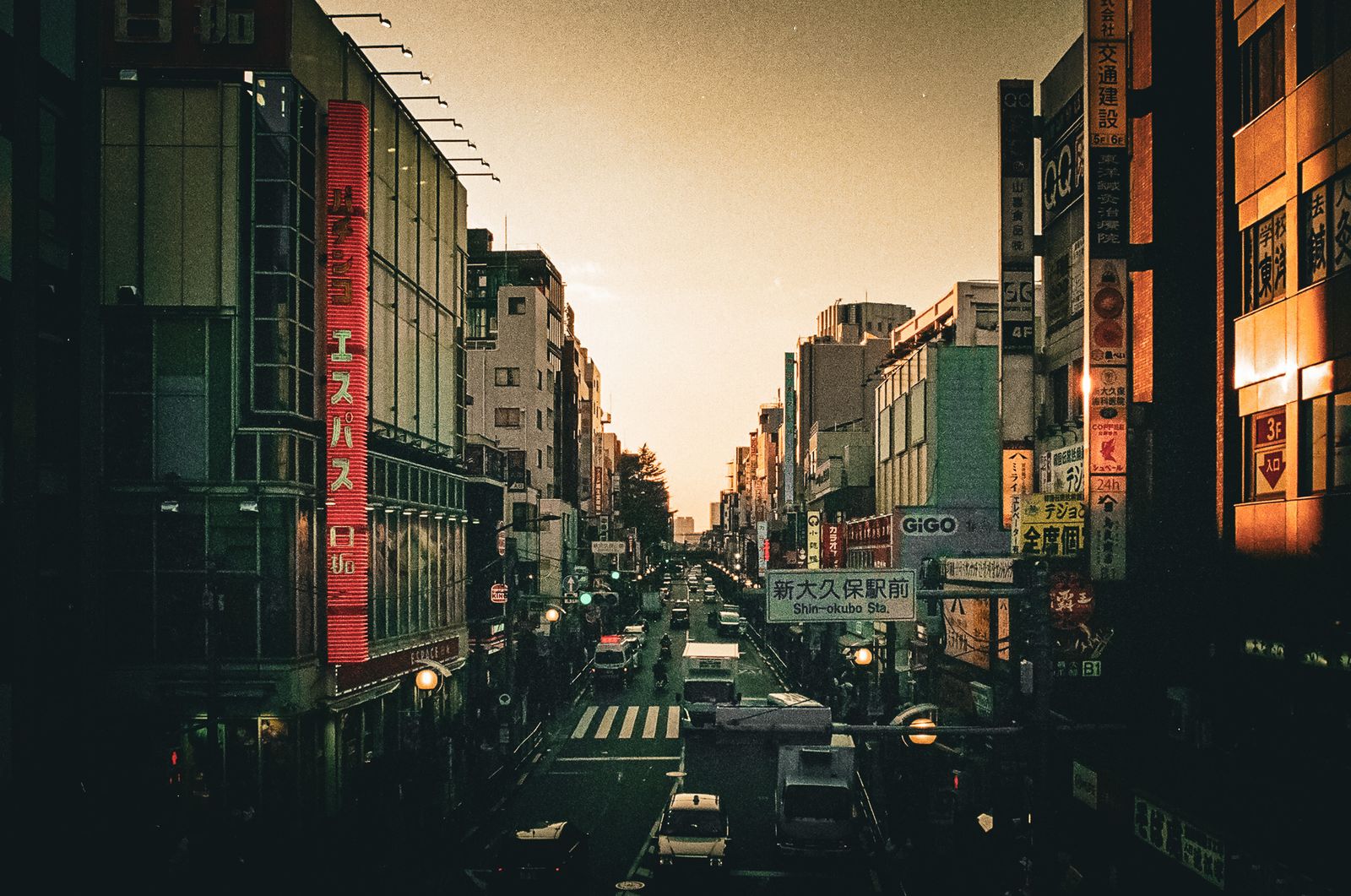 Shin-Okubo at dusk — Shin-Okubo, Shinjuku, Tokyo
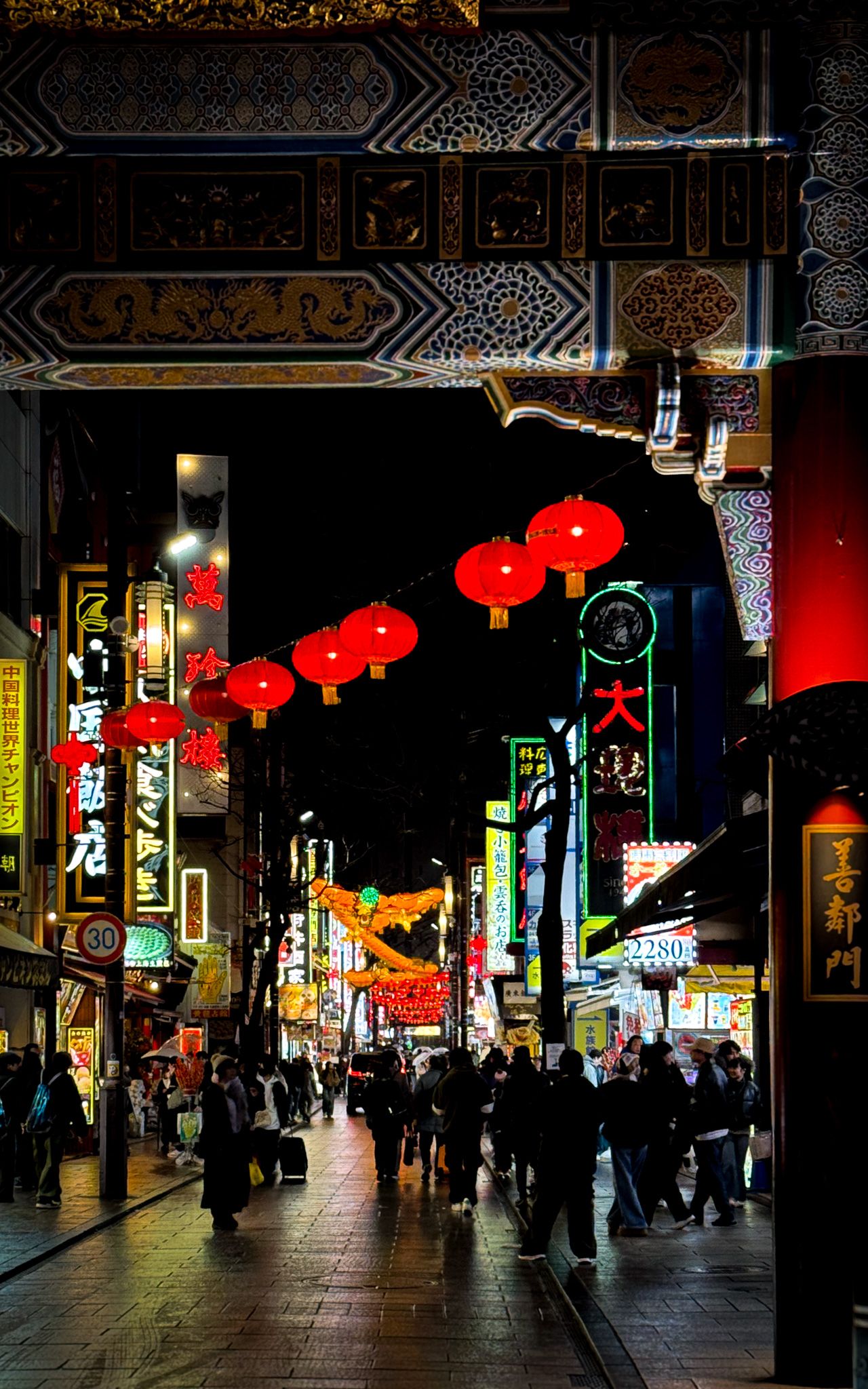
Shinjuku at dusk from a footbridge, looking down a six-lane avenue with neon and traffic and a million people all somehow moving without collision. Ginza at mid-morning, quiet and expensive, the department stores just opening, a cyclist weaving through election posters on a backstreet. Shin-Okubo at evening, signs in Korean and Japanese and Nepali, the smell of hot food from a dozen different kitchens, a traffic signal turning green into a crowd that moved like water. Every neighbourhood had its own light, its own speed, and the transitions between them were never gradual. You crossed a street and you were somewhere else entirely.
I shot the whole trip on a Canon F-1n loaded with Fuji 400 pushed to 200, which gave me that slightly warm, slightly overexposed palette I wanted for winter light. The 28mm stayed on for almost everything. Tokyo rewards a wide lens. There is so much happening in every frame that a tighter focal length just cuts out the context. The Canonet QL17 came out for Golden Gai and the evening bar runs, something smaller and quieter for spaces where a big SLR would have been obtrusive.
The overnight to Kyoto was a deliberate change of pace. Shinkansen down, a walk along the Kamogawa River in winter light. Kyoto Beer Lab near the station, run by an Australian called Tom, served excellent beer in a stripped-back space that could have been in Melbourne. Kyoto Brewing Company, further south, was doing things with saison and farmhouse styles that put them in a completely different category from the Tokyo scene. Different water, different attitude, different beer.
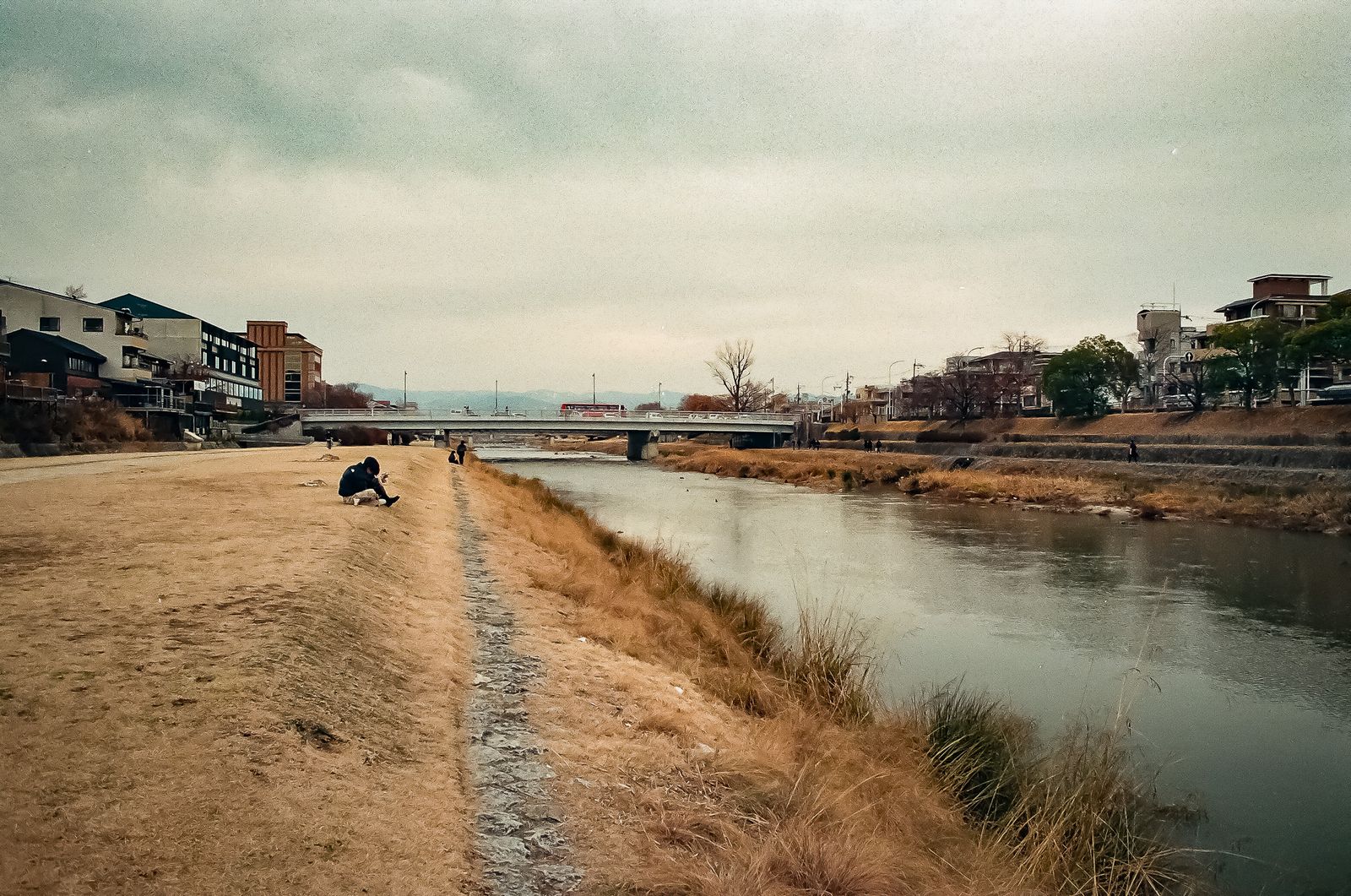 Riverbank in winter — Kamogawa, Kyoto
I walked the Kamogawa at sunset and it was one of those moments that you cannot photograph because the photograph would not carry the temperature of the air or the sound of the water or the fact that you were standing completely still in a city of 1.5 million people and nobody was asking you to move, buy something, or be anywhere else. Kyoto gives you permission to stop, which is a rare thing in any city and almost unheard of in Japan's travel culture, which tends to push you through sites at speed.
From Kyoto I carried on to Osaka to see an old friend. One night, which is not enough for a city that size and that volume, but enough to eat well and catch up over beers in Namba. Osaka has a different energy from Tokyo and Kyoto both. Louder, less curated, more willing to shout about itself. Dotonbori at night is sensory overload, neon reflected in the canal and the smell of takoyaki from every second shopfront, and my friend said the locals consider it slightly embarrassing in the way that Times Square embarrasses New Yorkers, which only made me like it more. We ended up at a standing bar under the railway tracks eating kushikatsu and talking about things that had nothing to do with Japan, which is what old friends do when you put them in a new city. The last train back was not the last train I wanted to take, but it was the right one.
On the last morning I went back to Asakusa. Senso-ji before eight, almost empty, the incense still hanging in the cold. I bought a can of hot coffee from the same machine as day one. Walked the same streets. Nothing had changed except me. I understood the rhythm now. I knew which turns led where. The neighbourhood had stopped being foreign and started being familiar, which is exactly the moment a place stops being a destination and starts being somewhere you have actually been.
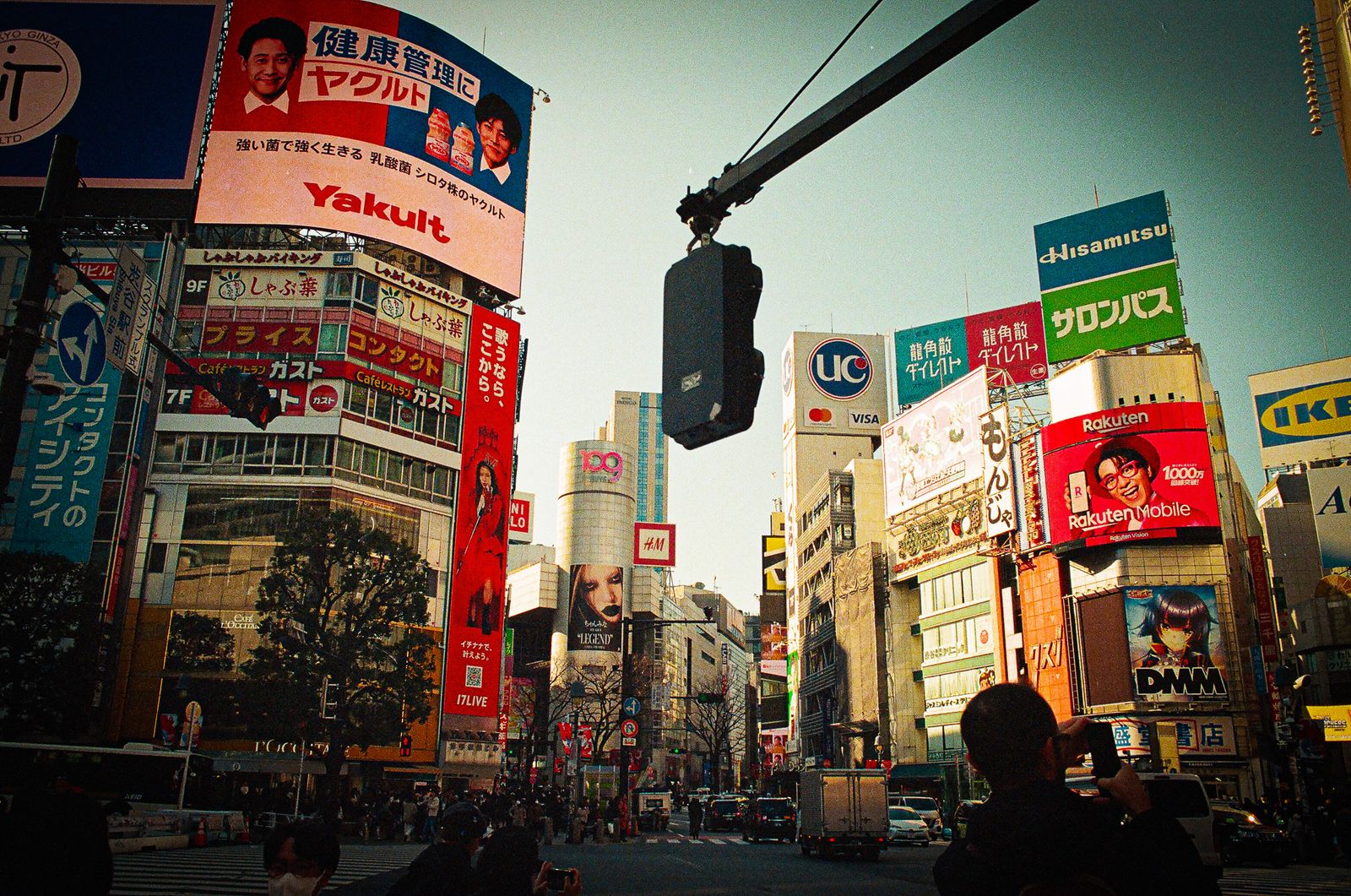 Signs and a traffic signal — Shin-Okubo, Shinjuku, Tokyo
On the flight home I sat in an aisle seat with sixteen hours ahead of me and a camera bag full of exposed Fuji 400 under the seat in front. Somewhere over the Pacific I caught myself reaching for my Suica card to buy a coffee from the drinks cart. The gesture was automatic. Eight days and my hand already knew what to do.
Do not expect everyone to speak English. Most people will not, and that is not a problem to solve, it is the country being itself. Learn a few phrases, bow when they bow, and carry Google Translate on your phone because it works and nobody will think less of you for using it. The real unlock is a global SIM. Something like Yesim or the excellent Honest SmartSim gets you on data the moment you land, no hunting for airport Wi-Fi, no fumbling with pocket routers, just connectivity from the gate. In a country where every train connection, every map lookup, every translation runs through your phone, being online from minute one is not a convenience. It is infrastructure.
I went for eight days. I have been thinking about it every day since. That is probably all you need to know.
