A Short Guide to Beer in Ukraine
I really wanted to call this “A Short History of Beers in Ukrainian.” I really did. What you’re getting instead is a short guide to beer in Ukraine: rough notes, some rubbish information, and an indication of the lengths I’ll go to for a decent pint.
I’ve been chewing on this since I got back. Plenty of British visitors go to Ukraine with no interest whatsoever in what’s in the glass, which is their loss. If you’re heading over for Euro 2012 or otherwise, there is a scene well worth finding.
I’ve since done Belgium and Germany. Ukraine is a different animal entirely: a country with its own long brewing tradition that most of Western Europe has simply never bothered to look at.
The alphabet, Cyrillic, was going to make reading labels near impossible, or so I assumed. As one does when heading somewhere far out, I got on RateBeer, punched in Ukraine and had a look at who’d already been. Turned out that ticks and scoops were not un-plentiful. Fair game.
Practical note. Brits don’t need a visa. If a Ukrainian wants to come here, they have to apply to Her Majesty’s Border Authority, or as it’s now less well-named, the UKBA. Draw your own conclusions.
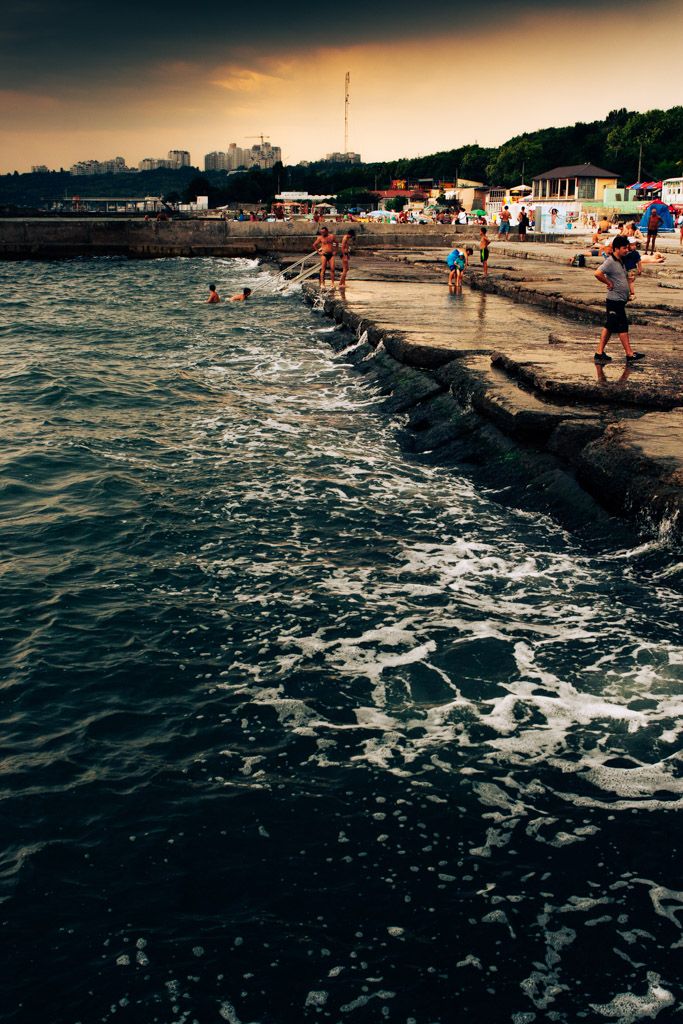 Bathers on a sea wall — Odessa
Ukrainian history, briefly
Long and proud. Kyivan Rus was arguably the most powerful state in medieval Europe, and Kyiv is where it was governed from. It fell to the Mongols. The western half spent four centuries inside the Polish-Lithuanian Commonwealth. Then the Russian Empire swallowed most of it in the 18th century, at real cost to the language and the culture, both of which were suppressed rather than absorbed. There was a fleeting independence at the end of the tsars, then the USSR from 1922, and two devastating famines (the Holodomor of 1932 to 33, and 1946) either side of a brutal Second World War. Chornobyl in 1986 was another disaster, though one now generally credited with galvanising the independence movement.
Sovereignty was declared in 1990, independence in December 1991 with a ninety percent yes vote. The nineties brought oligarchy, hyperinflation and cronyism. That came to a head in the disputed 2004 presidential election and the Orange Revolution, which put Viktor Yushchenko in. The coalition then fell apart, and with a fine sense of irony, his old rival Viktor Yanukovych won the next round.
Odesa
Odesa (Ukrainian Одеса) is the capital of Odesa Oblast, a big Black Sea port and the fourth largest city in the country, a shade over a million people. There was a settlement here long before the Russian Empire arrived, the Ottoman town of Khadjibey, taken five years before Catherine the Great refounded the place in 1794. Four foreigners in Russian service did much of the building: one talked the empress into it, one grew it into one of the empire’s largest cities inside eleven years, one made it a free port, one drew the plan.
The architecture is Mediterranean more than anything Russian, heavy on French and Italian influence, some Art Nouveau, Renaissance and Classicist mixed in. Free port from 1819 to 1858, then the most important trading port on the Black Sea, and a naval base under the Soviets.
The place is genuinely mad, in the best way. Beautiful heirloom buildings, insane nightclubs, apparently the largest shopping area in the world, and the Potemkin Steps up to the Duc de Richelieu monument.
The beer
I was expecting pale lager, followed by pale lager, chased with stronger pale lager. Carlsberg and InBev have been throwing money at the place, bless them. But RateBeer suggested a fair number of brewpubs and smaller efforts. Perhaps it wasn’t going to be as grim as I’d assumed.
Beer styles
The Lonely Planet compares Ukrainian beer with Czech, and it holds up. Ukraine works through much the same German lager repertoire as the Czechs, with a handful of local twists, and the quality is comparable. Ukrainian pale lagers are, in general, well made. The main ones I met:
Svitle, meaning light. Standard pale lagers, four to five percent. Low on flavour, but mostly free of off-tastes and cleanly made. Best I had: Lvivske Premium (3.2). Worst: Taller (2.2).
Temne, meaning dark. Dunkels, again four to five, generally sweet, sometimes with roast and, if you’re lucky, a touch of spice. Off-tastes rare. Best: Obolon Oksamitove (3.2). Not enough of them to nominate a worst.
Mitsne, meaning strong. Six to eight percent, sweeter and denser than the svitles, usually a bit more hop, and they read like Scandinavian “gold” macro brews. Try Slavutych Mitsne or Arsenal Mitsne.
Bile, meaning white. German hefeweizens, but often spicier and more citric than the German versions, though not as far as a Belgian wit. There are also darker “whites” that trend sweet. Dnipro Bile and Chernihivske Bile Nefiltrovane.
Porter. There are a surprising number of them. Very difficult to find. My girlfriend’s dad opened a Lvivske Porter on the first night: rich, dark amber lager, serious prune and raisin, dark roast underneath. Impressive.
Thanks to Largsa for the help with those style notes.
Kvas
Then there’s kvas. Traditionally low in alcohol, brewed from bread, and rarely sold in bottles or in pubs. What you want is a little tank truck in the street, usually with a babusya manning it, ladling into plastic cups. For reasons I don’t quite follow, it has lower status than the German-derived lagers, which is a shame because some of the brewpubs make good versions. Best glass I had was at the bottom of the Potemkin Steps in Odesa, five hryvnia for a half-litre.
Two kinds, as far as I could tell. One is the traditional: brownish, hazy, rye bread, spice, yeast. The other is what you’ll find in bottles and pubs, and reads more like a soft drink with a caraway note. I never got a straight answer on the alcohol level. Three to four percent at the most, I’d think.
Beer in southern Ukraine is good and matches the hearty food properly. This is as good as some Czech beer. Two or three US dollars for a local beer in a restaurant, no need to fuss over import lists. There are several breweries near Odesa, but restaurants tend not to carry them because big-brewery money and schwag runs the taps.
Highlights, of sorts
Brewing Museum, Lviv
Do not miss. This is not a Disney-fied, over-romanticised version of brewing or the community around it, even though the Lvivske brewery clearly funds it, and yes, you exit through the gift shop. Lviv has been known for beer since the 15th century, and there has been a brewery on the site since 1715, started by Jesuit monks. That is a Ukrainian tradition the USSR inherited rather than created, though under Soviet rule this was the brewing capital of the whole union. Beer from here went to royal banquets in Austria-Hungary and Poland, and later to Kremlin banquets under the communists. Lviv sits in the same brewing belt as Germany and Bohemia, and the town itself is a very pretty Bamberg or Brugge of an old town.
Arena Brewpub, Kyiv
As nightclub venues in Kyiv go, Arena is the king. Dead centre, inside the round structure next to Bessarabsky market. Multiple floors, casino, sports bar, sushi restaurant, standard nightclub with a large VIP area, and, tucked into it, a brewery. Calling it a watering hole would be like calling the Black Sea a pond.
Big dance floor, big dancers, big prices, and the moneyed crowd don’t blink. Mojitos and martinis, new-money types and local celebrities. Not much of a surprise, since the place is partly owned by the Klitschko brothers, who show up in the first-floor sports bar often enough.
The brewery is on one of the levels, and it is genuinely one of the more bizarre rooms I’ve ever ordered a beer in. The beer itself was among the best we had on the trip, clean, brewpub-Germanic. Prices near double the local going rate. When I asked the brewer about duty, his answer was, “This is Ukraine. Sometimes we do, and sometimes, well…” and a shrug.
Pyvnyi Sad, Odesa
A small restaurant-brewery in the pretty City Garden near Derybasivska. Beer is good, English menu. Look for the “Hausbrauerei” sign and tell them you just want a drink at the bar, unless you want dinner, in which case, be my guest.
Pavel Grembowsky, former Ukrainian triathlon star, learned his brewing from the head brewer at Arena, and to my ear, has now overtaken him. Near-native English, very cool. I was, apparently, the first foreign brewer to visit, or, more likely, the first one to introduce himself.
A 500 litre copper Waschmann kit runs three times a day to keep up when the sun is out. The red and the pale lager, both unfiltered, come off Weyermann malts, fresh pellet hops and German-supplied fresh yeast. That plus the local water produces properly fresh lagered beer. Order it with a plate of pickles, smoky stringy cheese and a pretzel. No more than 50 hryvnia for a couple of half-litres and the noms.
If you’re in Odesa, this and the Gambrinus bar are the two best beer hangouts, plus a growler-fill shop nearby. The sunshine in Odesa was wonderful, warm, balmy days. Only downside is the management’s willingness to bend. A party of “famous people” from Russia rolled in and simply ignored the local smoking laws.
Lvivske Pivovar, Lviv
Probably the better of the industrial breweries in Ukraine.
Lustdorf Brewery, Odesa
Lustdorf combines a new conception of modern recreation’s style and classical quality of brewage and cuisine. This place is perfect not only for having good drinks and food but also for a successful business meeting, having fun with friends or even a romantic date.
…it’s a good brewpub out of town. They really do over-talk everything. The beer was OK brewpub beer, cold unfiltered lager. Worth the haul out? Perhaps, if you’re me, which is to say, nuts.
The short list
Kyiv. Arena (brewpub). Chato (brewpub).
Odesa. Pyvnyi Sad Vynohradov (brewpub). Lustdorf (brewpub). Odeska Pryvatna Pyvovarnia (brewery). Gambrinus (beer bar).
Overall
Ukraine sounds like a grim destination for a decent pint, and for the most part it is pale-lager country, but it is nowhere near as bleak as the reputation suggests. There are interesting styles, there are brewpubs, and the industrial beer is not at all bad. Prices are low. If you are looking outside the usual beery destinations, this is well worth a punt. Think first division football rather than Premier League.
Coming out of Ukraine, past the slow passport control, and with whatever we have going on at home with Dave and Nick, it is hard to be smug about anyone’s politics. Money talks there, as it does here. But I left thinking this is a country on the cusp of being a genuine powerhouse. Great produce, great climate, very cool people. I was sad to leave somewhere with such natural wealth and such interesting young people doing their own thing. I hope for the best for Ukrainians, and I hope people like Pavel Grembowsky make their country as amazing as it deserves to be.
Note: pectopah = restaurant.
